
Budgeting Tips for Beginners: First Month
Most first budgets fail in the same way. You build a beautiful plan on a Sunday, every category filled in, and by the second Thursday reality has walked straight through it. The plan was not wrong. It was built from guesses. The most useful budgeting tips for beginners are about getting real numbers first and making the plan second.
This guide is a first-month checklist. Four weeks, one main task per week. It follows the structure the US Consumer Financial Protection Bureau uses in its free materials, and it shows how to do each step in a phone app without connecting a bank account.
The four steps the CFPB uses
The CFPB breaks budgeting into four parts in its guide on how to create a budget and stick with it:
- Identify your income.
- Track your spending.
- Map when your bills are due against when your income arrives.
- Build a working budget from those three.
Its one-page monthly budget form is even simpler: list your income, list your spending, subtract. If you only ever use one budgeting tool, that sheet is enough to start. The checklist below just spreads the work over a month so it does not all land on one evening.
The first-month checklist
Week 1: write down what comes in
- List every source of money for the month: wages, side work, benefits, support from family.
- Note the date each one arrives.
- If your income changes month to month, write down the lowest recent month, not the average.
Week 2: track what goes out, without judging it
- Log every purchase for seven days, including small ones.
- Do not try to spend less yet. This week is for seeing, not fixing.
- Use broad categories: housing, groceries, transport, bills, eating out, other.
Week 3: map the bills
- List every fixed bill with its due day: rent, utilities, phone, loan payments, subscriptions.
- Mark any bill that falls before your income arrives. That gap is where most money stress comes from.
- Cancel or pause one subscription you would not sign up for again today.
Week 4: build the first real budget
- Add up income (week 1) and subtract fixed bills (week 3).
- Split what is left across your flexible categories, using week 2 as a guide.
- Set a limit only for the two categories that surprised you most. Leave the rest alone for now.
- Pick a day next month to repeat week 4 with better numbers.
That is the whole first month. The CFPB’s Your Money, Your Goals toolkit has more worksheets if you want them, including a spending tracker and a bill calendar.
Doing the checklist in Unutma
You can do all of this on paper. If you want it on your phone, here is where each step lives in Unutma’s Economy tab, which is titled Budget:
| Week | What to do | Where in Unutma |
|---|---|---|
| 1 | Record income | Add transaction › Income, with a category such as Salary or Freelance |
| 2 | Log spending | Add transaction › Expense, or type “spent 12 on lunch” into the assistant |
| 3 | List bills with due days | ”Bills & Installments” › Add Bill / Installment, with the day of the month |
| 3 | Rent, salary and other repeats | ”Recurring” › Add Recurring |
| 4 | Set limits for two categories | ”Monthly Budget” › Set Budget |
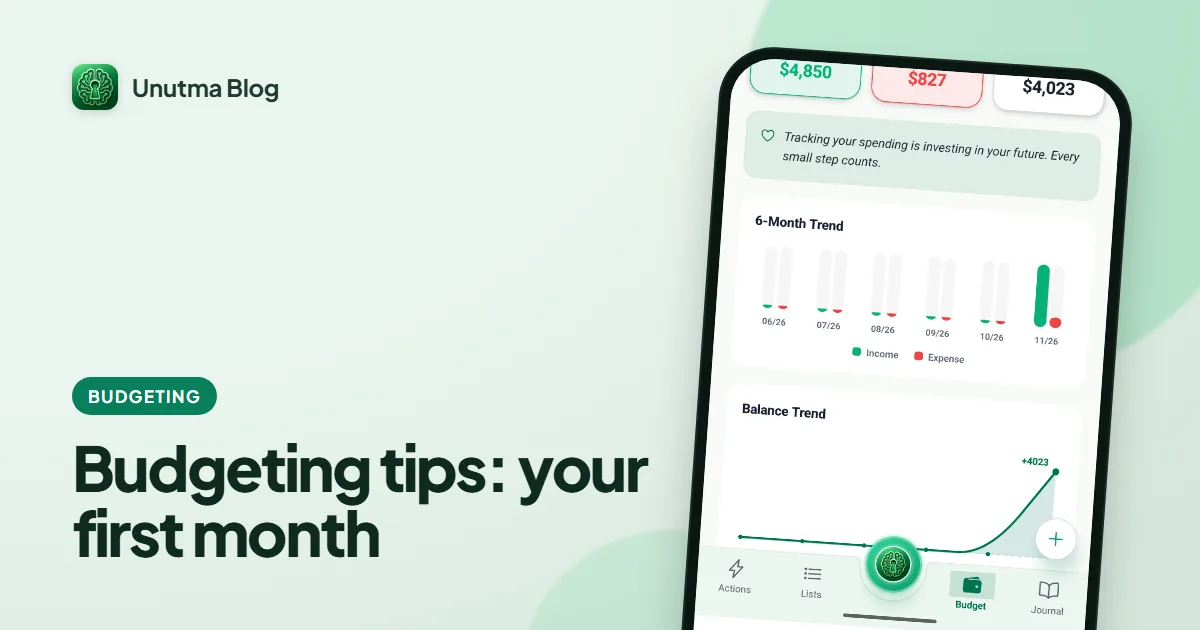
| Every week | See where it went | ”By category” and the 6-Month Trend |
There is no bank connection. Every entry is typed or spoken by you, which is slower. It also means your transactions stay on your phone and nobody else sees them. The budget is unlimited on the free plan. For the full feature list, see our guide to the expense tracker without bank linking.
Five mistakes beginners make
- Budgeting from memory. Guesses are usually too low for food and too high for bills.
- Too many categories. Fifteen categories is a spreadsheet hobby. Six is a budget.
- Quitting after one bad week. A blown category is information, not failure.
- Ignoring timing. A budget can balance for the month and still fail on the 12th.
- Copying someone else’s percentages. Rules like the 50/30/20 budget rule are a starting shape, not a target you must hit.
Who this checklist is not for
If you are behind on essential bills or dealing with debt collectors, a budget is only part of the answer. Look for free, non-profit help in your country. The CFPB toolkit above includes debt and bill-prioritising worksheets that are a better first step than a spending plan.
What to read next
If week 2 felt hard, read how to track personal expenses for a 30-day logging template. For splitting your money into needs, wants and savings, see the 50/30/20 budget rule. And to build a monthly money check into your week, see our weekly planning tips. If you are budgeting to save for something specific, see how to set and track goals.
Frequently asked questions
What is the easiest way to start a budget?
List income, list spending, subtract. The CFPB’s one-page monthly budget form does exactly that.
How long does it take to make a first budget?
About a month if you base it on real spending. You can draft one in an evening, but expect to rewrite it after four weeks of data.
Should I connect my bank account to a budgeting app?
It saves typing. It also means a third party can read your transactions. Manual entry is slower and keeps them private. Choose the trade you are comfortable with.
How many budget categories should a beginner use?
Five to eight. Merge categories until tracking feels boring.
What if my income changes every month?
Budget from your lowest recent month. Anything above that goes to savings or debt when it arrives.
Bottom line
The quiet truth behind most budgeting tips for beginners is that the first month is for collecting numbers, not for being disciplined. Track for a week, map your bills, and only then set limits. A plan built from your own numbers survives the second Thursday.